Category: food writing

  • Do the lampredotto

    Do the lampredotto

    Nina Mukerjee Furstenau's avatarPlated

    By Claire Lardizabal
    image2

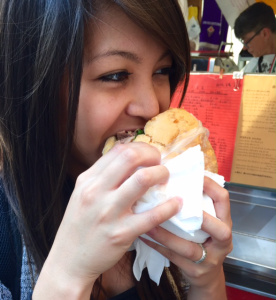
    FLORENCE, Italy—I took a deep breath and looked at the hot sandwich in my hands. Between a golden brown panino bun, smothered in parsley sauce, were the cooked innards of a cow stomach. I was about to take a bite of Tuscan street food, lampredotto.

    Beatrice Trambusti asked me if I wanted it spicy. Beatrice, along with her mother and brother, opened the Lupen E Margo food stall 30 years ago near Mercato Centrale. I said yes, but only a little, as she added a teaspoon of green chili sauce. Beatrice handed me my lampredotto in a convenient plastic wrap with extra napkins.

    Eating lampredotto standing up requires a certain grace. The local Tuscans stared at me as I tried to take a bite, then another, as chunky pieces fell to the ground for the pigeons to devour. I had to sit down to enjoy it.

    View original post 126 more words

  • Granitas beat the heat

    Granitas beat the heat

    Nina Mukerjee Furstenau's avatarPlated

    By Claire Lardizabal
    image1 (2)

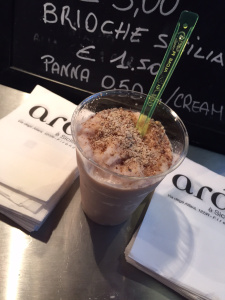
    FLORENCE, Italy— At the Mercato Centrale, stalls of purses, scarves and various trinkets surround the massive complex while inside local meat and produce vendors thrive. Upstairs, tourists and locals alike can also find the Arà: è Sicilia granita stand for a refreshing, sweet treat. The Sicilian granita is Italy’s own rendition of the slushy, made of sugar, ice and many flavors, but it holds its weight like a sorbet. Granitas can be found all over Italy, but are more popular in southern regions such as Campania because of warmer climates.

    The festive Arà stall can be found by the market’s interior stairway. The flavored shaved ice is made every morning and is stored in deep silver cylinders.

    Granitas can be served with a brioche or cream for an extra charge. Generous samples of coffee, lemon, almond, strawberry or cherry granita are given on neon plastic spoons. I…

    View original post 75 more words

  • Panna cotta anyone?

    Panna cotta anyone?

    Nina Mukerjee Furstenau's avatarPlated

    By Claire Lardizabal
    image1

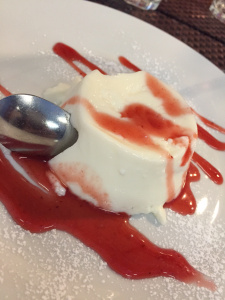
    FLORENCE, Italy—The white gelatinous dome drizzled with dark pink raspberry sauce wiggled as our server brought it towards the table.

    “Panna cotta?” he asked.

    I claimed it and sliced my spoon into the custard-like concoction, ignoring the fact I spent the last 45 minutes consuming bread, house Chianti, fresh bruschetta and lasagna.

    The spoonful melted in my mouth. How can this little dome of perfection be so sweet, light, creamy yet rich all at once? The panna cotta was devoured within minutes, a simple and delicate ending to another traditional Italian meal.

    Panna cotta translates as cooked cream. No one knows of its exact genesis, except that the dessert began showing up in the northern Italian Langhe region of Piedmont in the early twentieth century. Panna cotta is made like Jell-O, except gelatin and milk is melted into boiled cream and sugar, then cooled into molds in…

    View original post 152 more words

  • For the love of cheese

    For the love of cheese

    Nina Mukerjee Furstenau's avatarPlated

    By Claire Lardizabal
    _DSC0045

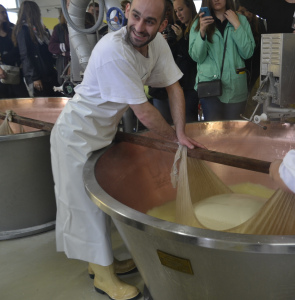
    FLORENCE, Italy – Marco Cavani began the San Michele Parmigiano Reggiano factory eight years ago with his wife, Samuela. Samuela grew up making cheese and brought her knowledge to the table when they began their business.

    The Cavani’s Parmigiano Reggiano products are labeled DOP (protected designation of origin). The label represents authenticity and distinguishes it from imitators. In Parma, an inspector comes to businesses like the Cavani’s, and inspects every wheel to ensure quality product true to the region.

    When we entered the facility, we were asked to cover our feet with electric blue shower caps to prevent dragging in contaminants. Steam was already rising from 1,000 liters of milk in each of three deep, copper vats. After reaching 17°C, rennet, an enzyme that causes milk to become cheese, was added and contined to heat the milk until it reached 27°C. Even though the Cavani’s used modern…

    View original post 245 more words